Engineering Methodology

Engineering &
Project Development
Approach

We apply a structured, stage-based engineering methodology that ensures both technical reliability and cost efficiency — progressing from concept to installation without unnecessary upfront expenditure.

Stage-Gate Process
Post-Approval Detailed Design
UAE-Licensed Execution
No Hot Work Throughout
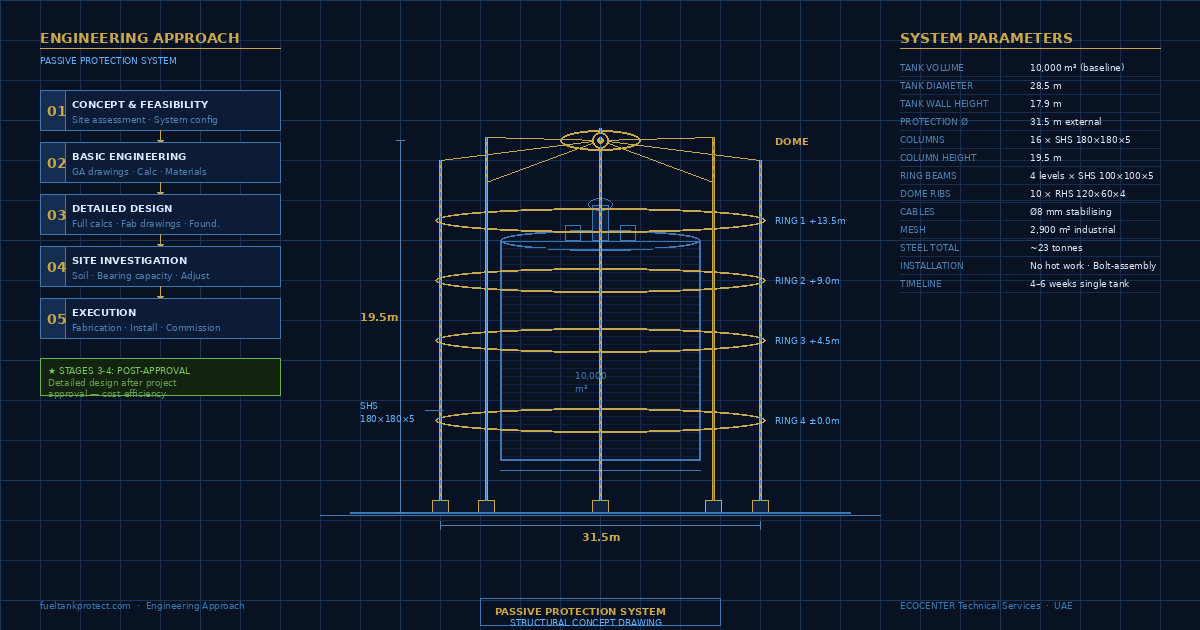
Passive Tank Protection System — Engineering Blueprint
Structural Concept Drawing — 10,000 m³ Reference Tank · FuelTankProtect.com
Cost-Efficient Progression
Technical Reliability
Clear Decision Gates
Risk-Aligned Scope

Five-Stage Methodology

Each stage has a defined deliverable and decision gate. Detailed engineering and site investigation are performed after project approval — ensuring cost efficiency and accurate, site-specific design.

01
Stage 1
Concept & Feasibility
Initial engineering assessment of the site and asset. We develop the protection concept, define system configuration, and establish preliminary load assumptions — without committing to detailed design expenditure.
Initial assessment of site conditions and tank geometry
Concept design and system configuration selection
Preliminary load assumptions (wind, seismic zone, impact)
Protection level definition and system boundary
Solution presentation to client engineering team
Objective: Define the most appropriate protection level for the specific asset
? H? CONCEPT STAGE
02
Stage 2
Basic Engineering
Development of general arrangement drawings, preliminary structural calculations, and material definitions. This stage validates technical feasibility and establishes the project scope with sufficient precision for commercial decision-making.
General arrangement drawings (plan, elevation, sections)
Preliminary structural calculations and member sizing
Definition of materials, sections, and system components
Installation methodology and sequence
Preliminary bill of materials and cost framework
Objective: Validate technical feasibility and define project scope for commercial approval
GENERAL ARRANGEMENT BASIC ENGINEERING
03
Stage 3 — Post-Approval
Detailed Engineering
Full structural calculations, fabrication drawings, foundation design, and load analysis. This stage is executed after client approval — ensuring that detailed design investment is justified by a confirmed project scope and budget.
Full structural calculations per EN/AISC standards
Fabrication drawings for all structural elements
Foundation design — bearing capacity, anchor bolt layout
Load analysis: wind (UAE wind zone), impact, seismic
Connection details — bolted joints, base plates, node plates
Material specifications and inspection requirements
Installation procedure and HSE documentation
Objective: Ensure safe, code-compliant, and fully buildable design documentation
H=19.5m Nwind = 1.4 × qref × ce × cf × Aref qref = 0.59 kN/m² (UAE Zone II) SHS 180×180×5 → OK ✓ Bolt M20 8.8 DETAILED ENGINEERING
04
Stage 4 — If Required
Site Investigation
Where soil conditions are uncertain or foundation design requires verification, site investigation is conducted. This stage ensures foundation design is appropriate for actual bearing capacity — preventing both over-design and under-design.
Geotechnical investigation — borings or CPT tests
Soil bearing capacity verification
Foundation depth and type confirmation
Site-specific adjustments to foundation design
Coordination with existing underground services
Objective: Ensure foundation design matches actual site conditions
GRADE LEVEL ±0.000 LAYER 1 — Fill / Sandy soil LAYER 2 — Dense gravel / qa = 200 kPa LAYER 3 — Rock / qa = 500+ kPa CPT SITE INVESTIGATION
05
Stage 5
Execution & Installation
Fabrication of structural components via approved partners, followed by site installation and system commissioning. All installation is bolt-assembly — no hot work, no welding on site — enabling work on operational tanks in hazardous classified zones.
Fabrication via approved structural steel partners
Anti-corrosion coating and surface treatment
Foundation installation — concrete works, anchor bolts
Column erection and ring beam installation (bolt-assembly)
Dome structure and mesh installation
Bronya thermal/fire coating application if included
System commissioning and handover documentation
Objective: Safe, compliant installation without operational disruption — 4 to 6 weeks typical
FOUNDATION EXECUTION & INSTALL
Engineering Sequence — Why It Matters
Detailed engineering and site investigation are performed after project approval — not before. This is a deliberate design of our process.

Commissioning full structural calculations before commercial agreement creates unnecessary upfront cost for the client and risks misalignment between engineering assumptions and actual project scope. Our stage-gate approach ensures that detailed design investment is always justified by a confirmed project boundary, site conditions, and budget framework.

We develop engineering solutions progressively — aligning cost, risk, and technical requirements at every stage.
المنهجية الهندسية

نهج التصميم والتنفيذ المرحلي

نطبق منهجاً هندسياً متدرجاً يضمن الموثوقية التقنية وكفاءة التكلفة في آنٍ واحد — من مرحلة الدراسة الأولية حتى التركيب والتشغيل.

المرحلة 1
المفهوم والجدوى
تقييم أولي للموقع، تطوير المفهوم، تحديد مستوى الحماية المناسب.
المرحلة 2
التصميم الأساسي
رسومات عامة، حسابات أولية، تحديد المواد والمنهجية.
المرحلة 3 — بعد الموافقة
التصميم التفصيلي
حسابات كاملة، رسومات تصنيع، تصميم الأساسات، تحليل الأحمال.
المرحلة 4 — عند الحاجة
الدراسات الجيوتقنية
تحقيق من قدرة التحمل، تصميم الأساسات بناءً على ظروف الموقع الفعلية.
المرحلة 5
التنفيذ والتركيب
التصنيع، التركيب بالبراغي فقط دون أعمال سخنة، التشغيل والتسليم. المدة: 4 إلى 6 أسابيع.
ملاحظة مهمة
يتم التصميم التفصيلي والدراسات الجيوتقنية بعد موافقة العميل، لضمان كفاءة التكلفة ودقة التصميم.
Start With
Stage 1

A confidential site assessment and concept feasibility study is the entry point. No commitment to detailed design until the concept is validated and scope is agreed.

Request Stage 1 Assessment Back to Main Site