Strategic Infrastructure Proposal · UAE
Passive Engineered
Protection for Fuel
Storage Tanks
Multi-Layer Risk Reduction Concept for Critical Energy Infrastructure
50yr
Certified mesh
service life
5000kJ
Impact absorption
capacity
45T
Single-ring load
(Corderie Dor)
0
Load transfer
to tank shell
ECOCENTER Technical Services LLC  ·  UAE
Technical Concept Lead: Pavel Matyunin
Strategic Context
Why This Matters Now
UAE Energy Infrastructure · Fujairah
🛡️
Critical Storage Assets
Fujairah serves as the UAE's strategic energy hub outside the Strait of Hormuz, storing millions of barrels of crude and refined products essential to global supply chains. Every tank is a sovereign asset.
⚠️
Evolving Risk Environment
Recent incidents demonstrate emerging aerial and asymmetric threats targeting upper-zone infrastructure — creating vulnerability that conventional perimeter security does not address.
Resilience Imperative
Operational continuity and fire-risk mitigation are paramount for sovereign energy infrastructure. Proactive passive protection preserves asset integrity without complex active systems.
Fujairah Oil Terminal
World's 3rd-largest
crude & products storage hub
Outside
Strait of Hormuz
100M+
Barrels regional
storage capacity
New
Aerial threat
vectors emerging
$0
Power required for
passive system
"This proposal addresses the emerging need for enhanced passive protection of critical fuel storage infrastructure in a new regional risk environment."
INDUSTRY DATA
Environmental factors initiate 38% of atmospheric storage tank accidents. — Journal of Failure Analysis and Prevention, 2020
Risk Assessment
The Vulnerability
Upper-Zone Risk Exposure in Conventional Storage Tanks
01
Roof-Zone Equipment Exposure
Critical components — valves, measuring nodes, ventilation systems and access hatches — remain fully exposed. A single impact creates cascading equipment failures.
02
Operational Disruption Risk
Damage to roof-level instrumentation triggers immediate operational shutdowns — affecting inventory management, safety monitoring, and regulatory compliance.
03
Fire Escalation Consequences
Compromised roof structures lead to rapid fire escalation, vapor release, and potential domino effects across tank farm configurations — catastrophic outcomes.
Threat Parameters This System Is Designed For
Class M — Operational
5–15 kg  ·  25–40 m/s
Upper-zone scenario, directed or accidental contact
Class H — Enhanced
Up to 25–30 kg  ·  50 m/s
High-energy scenario, deliberate high-kinetic impact
* System is engineered for defined impact parameters — not for a specific threat model. Class selected jointly with client during Stage 1 assessment.
Engineering Principle
Controlled Deformation — Not a Rigid Barrier
The system absorbs energy in the air — before the tank is touched

"The system does not stop impact by force. It intercepts, deflects and dissipates energy in free air — at 2.5–3.0 metres from the tank shell."

TANK 2.5–3.0m offset ▼ IMPACT energy absorbed here MESH BARRIER
📍 Offset: 2.5–3.0m from tank
Impact is intercepted in air — not on the structure. The tank shell never receives the primary force.
🌊 Controlled deformation
Chainmail mesh absorbs and redistributes kinetic energy across the independent support framework.
📐 Residual clearance: 2.0–2.5m
Even after full deformation, physical separation between mesh and tank is maintained.
🏗️ Zero load transfer to tank
Independent RC foundations — tank structural integrity is never compromised.
Material Technology
Chainmail Mesh — Certified
European-tested · Russian-patented · 50-year service life
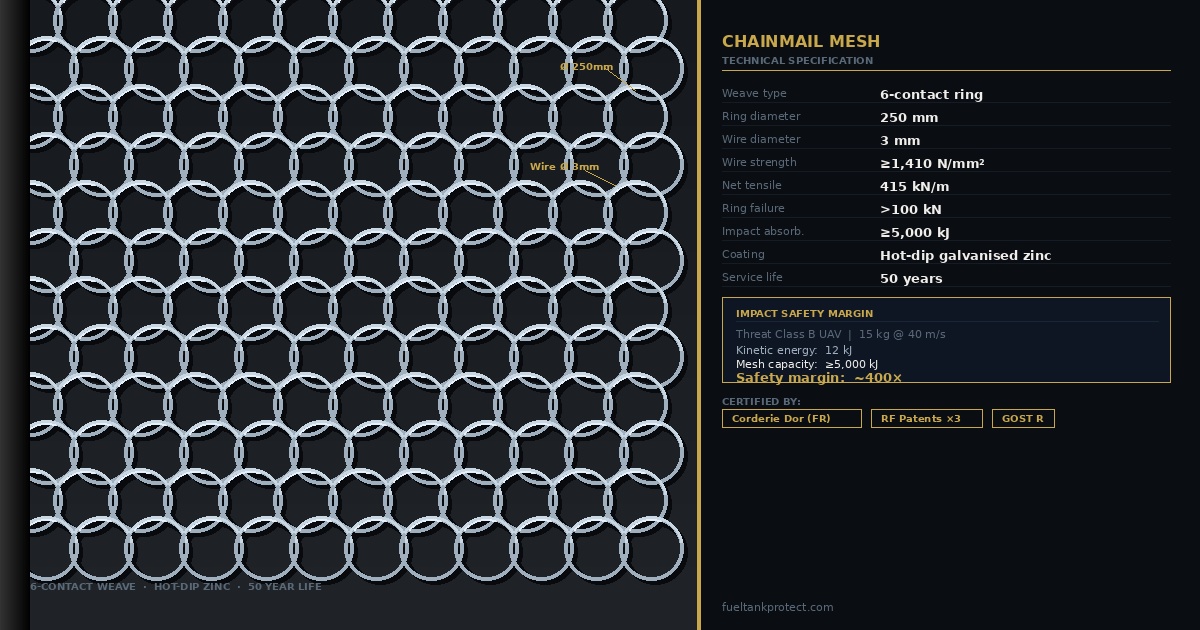
Chainmail mesh specification
6-contact ring weave · 250–420mm
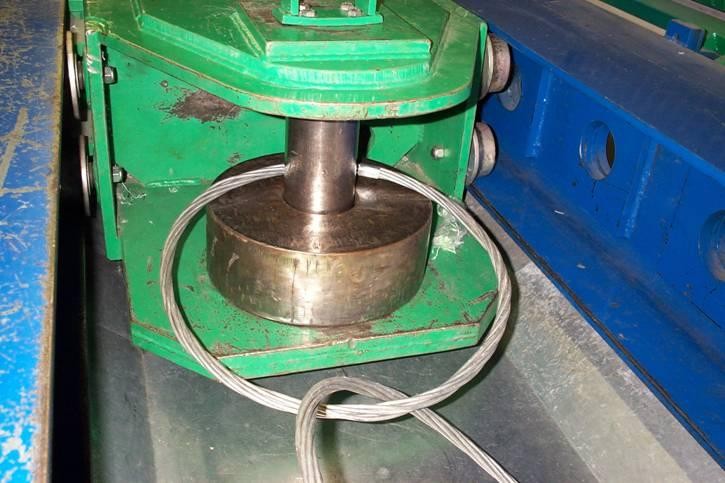
Ring test laboratory
Laboratory ring break test
Technical Specifications
Weave type6-contact ring weave
Ring diameter250–420 mm options
Wire diameter2.5–4 mm
Wire coatingHot-dip galvanised zinc
Tensile strength≥ 1410 N/mm²
Single ring break load≥ 100 kN (45T certified)
Impact absorption≥ 5,000 kJ
Net tensile strength415 kN/m (250mm)
Zinc coating220 g/m² (CITEM)
Service life50 years
🏅 Corderie Dor — France 2004
Certificat d'Essai · Ring 420mm · Result: 45T with rupture · DYNAFOR 100T E87A1 · Independent European laboratory — not our data
📋 CITEM Comparative Table
ASM nets resistance 16–50T · Zinc coating 220 g/m² · European benchmark comparison — used as industry reference
🇷🇺 RF Patents
№142708 — Anti-flood gabion  ·  №134179 — Rock-fall mesh  ·  №219142 — Steel pipe casing. All registered Russian Federation patents
✅ GOST R Certificate of Conformity
Russian Federal standards compliance · Production: ЮгСтройКомплект / Азов-Канат-сеть, Azov · UAE local production possible (4 machines, 700–750 kg/shift)
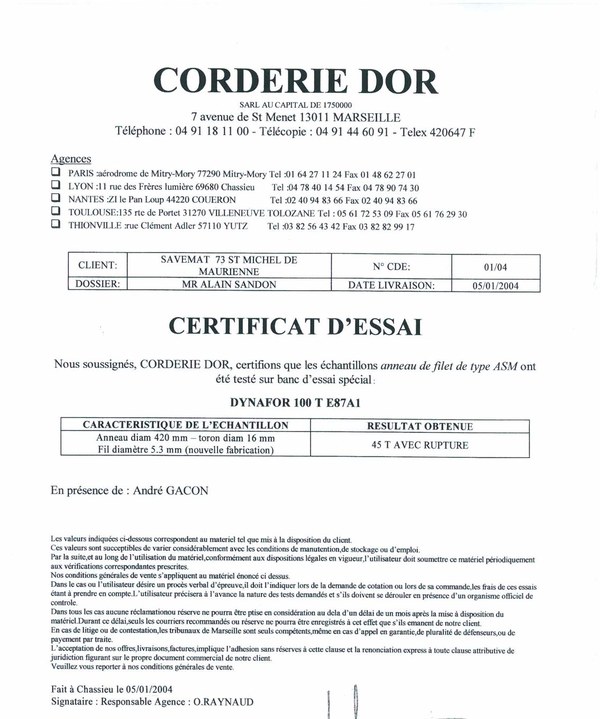
Corderie Dor Certificate
Corderie Dor Certificat d'Essai 2004 · Chassieu, France
Video Evidence
Impact Tests — See It Work
Certified laboratory impact tests · Available on request
Impact Test 1 — Dynamic load absorption
Real-time impact test demonstrating the energy absorption and deformation behaviour of the chainmail mesh system under dynamic loading.
Impact Test 2 — High-energy scenario
High-energy impact scenario showing mesh controlled deformation — the structure deflects, absorbs and redistributes force without catastrophic failure.
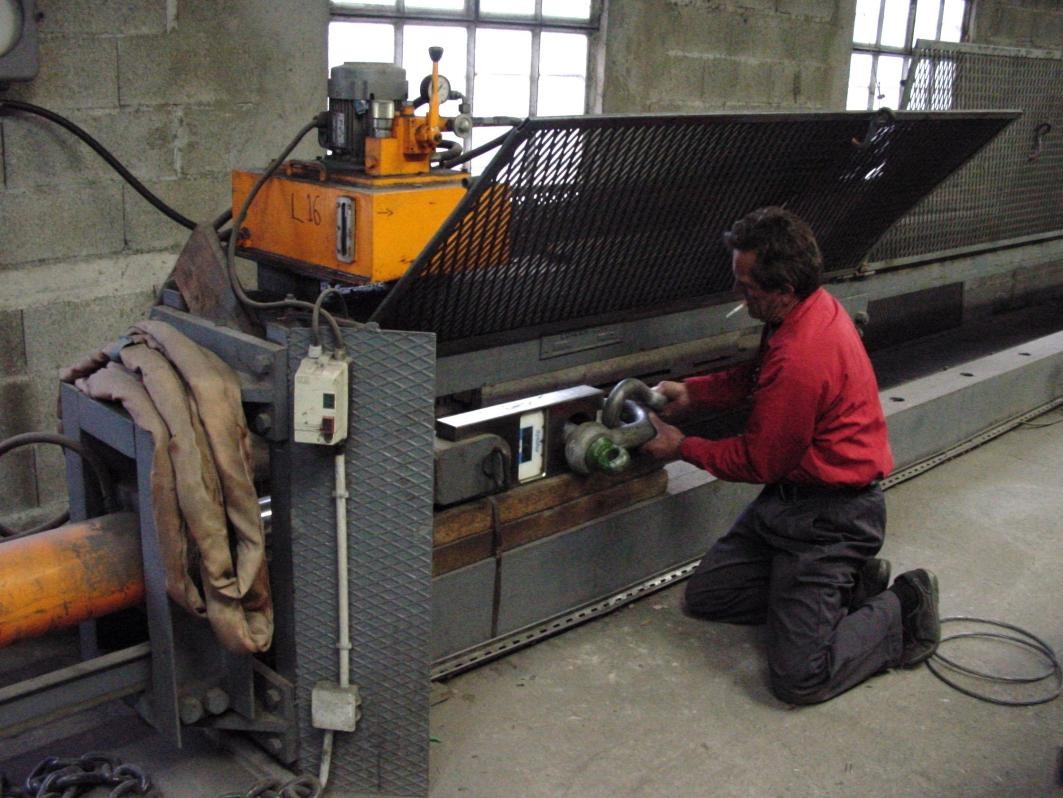
Lab engineer testing mesh
Laboratory testing setup — ЮгСтройКомплект / Азов
Test Results
Single ring break load >100 kN
Corderie Dor result 45T
Energy absorption ≥5000kJ
Engineering Solution
Independent Structural System
Passive Multi-Layer Protection · No Load Transfer to Tank
🏗️
Independent External Structure
Steel columns S355 on separate RC foundations. Zero structural connection to tank shell or roof. Tank experiences only incidental aerodynamic effects.
Multi-Level Ring Beam System
Horizontal ring beams + diagonal bracing create rigid structural cage around the tank perimeter. 2–4 levels, bolted node plates (10mm min).
🔵
Lightweight Dome Geometry
Upper support ring with dome structure and top mesh barrier for full roof-area protection. Radial ribs + cable integration create lightweight protective canopy.
🛡️
Vertical Perimeter Shielding
Chainmail mesh extends from foundation level to upper ring — creating continuous protective envelope with no unprotected gaps in coverage.
🔩
No Hot Work — No Shutdown
Bolt-oriented connections only. No welding, cutting or grinding during installation. Tank remains in full operation throughout. No HSSE hot work permit required.
Maintenance Access Preserved
Full access to roof equipment, instrumentation and safety systems maintained at all times. No protective system removal needed for routine maintenance.
Design Philosophy: Engineered protection that preserves tank operational integrity while adding resilient defensive layers. The tank never knows the system is there — until it's needed.
Deployment
Three Configurations
From Single Tank Pilot to Full Tank Farm Scale
01 · Pilot Recommended
Single Tank
Suspended Dome
  • Offset: 2.5–3.0m from tank shell
  • Residual clearance: 2.0–2.5m
  • Secondary cable system
  • No load transfer to tank roof
  • Installation: 4–6 weeks
Ideal proof-of-concept. Full monitoring & performance validation before scale-up.
02 · 15–25% Cost Saving
⬡⬡
⬡⬡
Square Cluster
4 Tanks
  • Unified perimeter system
  • Shared structural elements
  • Optimised material efficiency
  • Phased installation possible
  • Deployment: 3–4 months
Best economics per tank. Adjacent tanks share perimeter — no duplication of foundation work.
03 · Scalable
⬡⬡⬡
Linear Row
Portal-Cable
  • Modular, infinitely scalable
  • Reinforced end zones
  • Standard spanning elements
  • Adapts to existing row layout
  • Phased by tank priority
For linear tank farm arrangements. Rapid scale-up once pilot is proven.
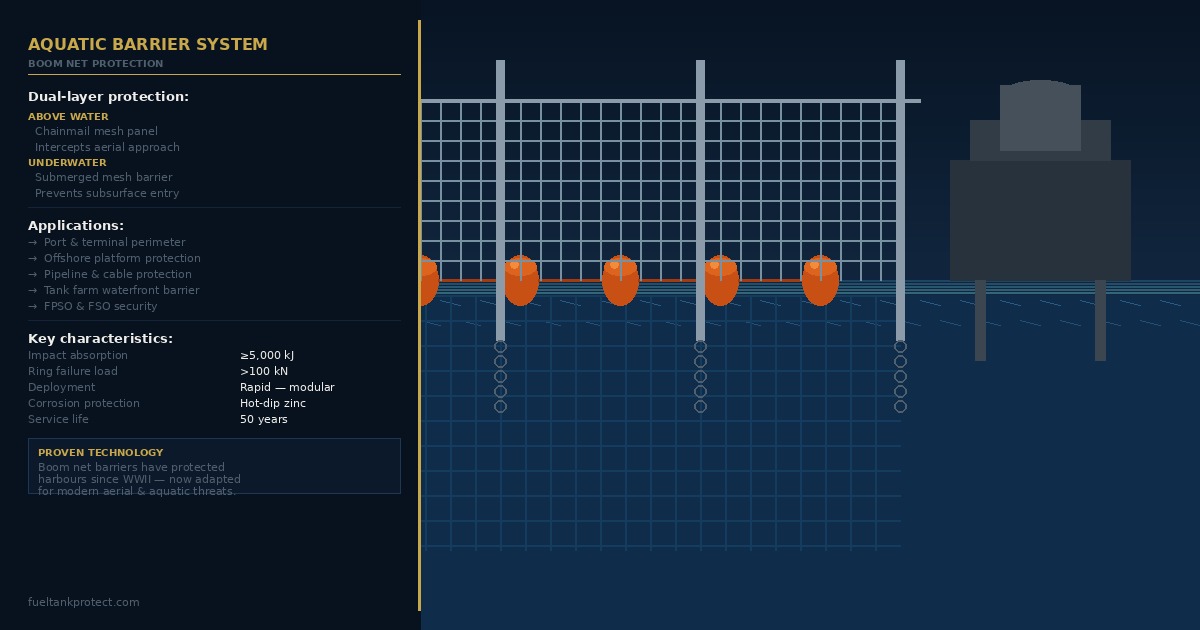
Boom barrier aquatic protection
Aquatic
Also available: Aquatic protection using boom-barrier chainmail systems for waterfront facilities and port-adjacent tank farms. Same certified material — adapted for water surface deployment.
Differentiation
Why This System — Key Advantages
Passive Engineered Solution vs. Alternatives
Feature This System Active Detection Rigid Barriers Do Nothing
Requires power / electronics ✗ None ✓ Always on ✗ None
Shutdown for installation ✗ None ✗ None ✓ Required
Load transfer to tank structure ✗ Zero ✗ Zero ✓ Often yes
Hot work on site required ✗ None ✗ None ✓ Often yes
Brownfield retrofit ✓ Yes ✓ Yes Limited
Proven material certification ✓ 45T cert No Varies
Maintenance access preserved ✓ Full ✓ Full Restricted
Tank operational during install ✓ Yes ✓ Yes ✗ No
Competitive Advantage: This solution addresses the three key deployment barriers — hot work requirements, mandatory shutdown, and load transfer concerns — that limit all conventional protection approaches.
Engineering Honesty
What We Guarantee — and What We Do Not
Engineering Honesty Is Our Competitive Advantage
✓ We Guarantee
Design to engineering norms
Structural analysis S355/C30/37 — all loads calculated per applicable standards. Documented and traceable.
Compliance with stated threat class
System designed for agreed Class M or H parameters. Threat model is the contractual baseline.
Manufacturing quality
Certified mesh — Corderie Dor, GOST R, RF Patents. Fully traceable certification chain.
Installation quality
Supervised installation; bolt-torque protocols; as-built documentation delivered on completion.
50-year mesh service life
Per certified material specifications — subject to periodic inspection per maintenance schedule.
✗ We Do Not Guarantee
Protection outside agreed threat model
If impact parameters exceed Class H design values, performance cannot be guaranteed. Scope must be defined.
Zero damage under any scenario
The system reduces probability and severity. It does not create an impenetrable barrier — no system does.
Protection from secondary fragmentation
High-energy events may produce secondary fragmentation that passes through mesh apertures.
Non-standard scenarios
Scenarios not covered in the initial threat model require additional engineering assessment and contract amendment.

"The goal is not a zero-risk guarantee — it is disciplined, honest risk reduction through engineered means."

Business Case
Cost vs. Risk
The Question Is Not Cost — It Is Acceptable Risk Level

Protection investment is 10–50× lower than potential loss from a single incident.

1M
AED/day
Operational downtime
5–50M
AED
Tank repair & decontamination
Uncapped
Environmental liability
regulatory risk
×3–10
Cascading domino
effect multiplier
📊
Pilot-First Capital Logic
Single-tank pilot keeps initial exposure minimal while generating full performance data. Stakeholder confidence built before broader capital commitment.
📈
Scalable CAPEX
Investment scales with asset prioritisation — highest-risk tanks first. Phased deployment aligned with budget cycles and maintenance windows.
🔧
No Production Loss on Install
No shutdown required. No hot work permit delays. No inventory displacement. Tank continues to operate fully throughout installation period.
🏭
Brownfield Asset Focus
Designed for existing infrastructure. No major civil works beyond column foundations. Adapts to varied tank diameters, heights and site conditions.
Engagement Process
From Assessment to Pilot
Six Stages · Clear Decision Gates · Pilot-First Philosophy
01
Confidential
Site Review
Tank farm configuration, site conditions, operational constraints under NDA
2–4 wks
02
Asset
Screening
Risk-based prioritisation of tanks: criticality, exposure, access
1–2 wks
03
Concept
Adaptation
Engineering for selected geometry, threat class, site conditions
4–6 wks
04
Pilot Engineering
Package
Detailed design, specs, installation procedures, safety docs
6–8 wks
05
Pilot
Implementation
Installation, commissioning, performance monitoring on baseline tank
4–6 wks
06
Scale-Up
Roadmap
Phased expansion based on pilot results and budget cycles
Ongoing
Pilot-First Principle
Start with one tank. Generate real performance data. Build confidence before committing capital to the full asset base.
4–6 wks
Single tank pilot
6–8 wks
Engineering package
3–6 mo
Typical tank farm
~20 wks
Site review → pilot
Who Calculates the Engineering?
Pavel Matyunin — Technical Concept Lead
3,000+ tanks serviced · Gazprom, Lukoil, Tatneft exposure · Deep knowledge of roof zones, valves, measuring nodes
Standards: S355 / C30/37 / ISO 12944 C5-M
Detailed Engineering includes licensed UAE structural engineer. Full local code compliance and permit-ready documentation.
Proof & Platform
"Where Are Your Completed Projects?"
An Honest Answer — and Why It Works in Your Favour
We are bringing this engineered solution to the UAE market as a pilot. The first client does not take a leap of faith — they validate a system built on certified materials, proven engineering principles, and a disciplined process.
What Is Proven and Certified:
✅ Chainmail mesh material
Corderie Dor 2004 · 45T certified · GOST R · 3 RF Patents — independent labs, not our data
✅ Structural engineering principles
Independent steel framework · No load transfer — textbook structural engineering, not a prototype
✅ Impact absorption physics
5,000 kJ capacity · 100 kN single-ring load · documented laboratory tests
✅ 50-year corrosion resistance
Hot-dip galvanised zinc · 220 g/m² · CITEM data — material-proven, not modelled
What the Pilot Delivers to You
Site-specific structural analysis and calculations
Full engineering package (ready for authority review)
Physical installation on one selected tank
Commissioning documentation and as-built drawings
12-month performance monitoring protocol
Scale-up roadmap based on real performance data
Minimum capital at entry → Maximum control over outcome
UAE Execution Platform
ECOCENTER Technical Services LLC
UAE Entity — Registration in Progress · LLC · Manager: Pavel Matyunin
Licensed: Electromechanical Equipment Installation · Metal Parts & Erections Contracting · Steel Products Installation · Industrial Installation Activities
Partners: Bronya UAE (RAK) · Thermal coatings since 2012  ·  Mesh: Азов-Канат-сеть, Russia
The Objective
Not theoretical
protection.
Practical reduction
of asset vulnerability
through a disciplined, locally executable,
passive engineering solution.
We welcome the opportunity to discuss a pilot engagement for your critical energy assets.
A confidential technical assessment can be arranged at your convenience.

Next Steps

1
Agree on Threat Model parameters (Class M or H)
2
Select pilot tank — geometry, priority, site access
3
Sign NDA for confidential site review (Stage 01)
4
Receive Concept Adaptation proposal with indicative parameters
📞
Pavel Matyunin  ·  +971 552 281 140
Pavel-800@yandex.ru  ·  fueltankprotect.com
Share this presentation
fueltankprotect.com/pitch
← → or click